
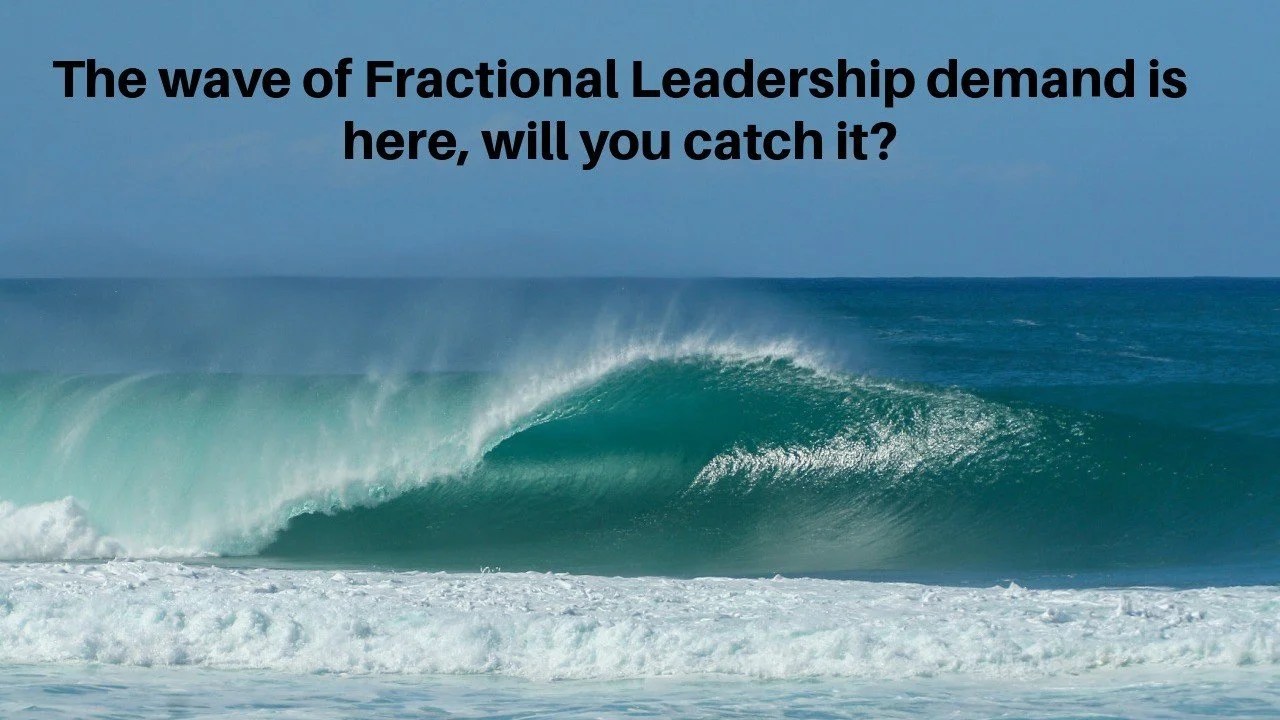
Demand for fractional leadership is not coming. It is here, and it is growing. Roughly a quarter of U.S. businesses already use fractional hiring, and that is projected to reach a third by the end of this year, with demand up nearly half year over year. Gartner projects that by 2027 more than 30% of midsize enterprises will have at least one fractional executive on retainer. The companies that were curious last year are expanding this year. This is a wave of adoption, and it is already moving. The question is not whether it arrives. The question is whether it carries you, or passes you by.
Here is what decides it. Not your title. Not your LinkedIn. One conversation, had well, over and over, with people who do not know you yet.
Where it breaks down
Most fractionals working today were hired by people who already knew them. The value question never came up, because the trust was already there. Then they step beyond those relationships and meet a stranger whose needs match their skills, and the conversation stalls. The owner hears "fractional," files it under part-time version of a familiar job, and asks the question that ends most of these meetings. If you are working for me fewer hours than someone else would, and charging close to what they would cost, where is the extra value?
The fractional cannot demonstrate the value, so they describe what they do. The owner nods politely and goes quiet. That moment is where a practice either becomes a business or quietly fades.
Why this is not a nice to have
Fractional leadership is a category still being created. Buyers mostly know the word. What they do not know is what it actually does, what it is for, and why it is worth it. Nobody is going to explain that to them except the fractional sitting across from them. Which means every fractional is, whether they like it or not, creating the market one conversation at a time.
Here is how a new category gets adopted, in plain terms. Nobody buys something they have never heard of. First a buyer has to learn that a new kind of help exists at all. Then they have to see that it fits a problem they actually have. Then they have to understand how it works well enough to believe it will pay off. Only then do they compare providers and choose one. Every buyer walks that path in that order, and in a brand new category almost all of them are still standing at the beginning of it. Somebody has to walk them down it. In an established category, advertising, word of mouth and years of familiarity do that work. In this one, none of that exists yet. The walk happens in conversation, or it does not happen.
In a mature market, buyers already want the thing. You get by signaling that what you offer is what they are already looking for. In a market being created, nobody is looking yet. You win by making people aware, and the people who cannot do that get lost in the crowd no matter how good they are. That is why the awareness-creating conversation is not a soft skill or a nice to have. Right now, at this stage of this market, it is the skill. It is the difference between catching the wave of adoption and watching it roll past you to someone who could explain themselves.
What the conversation does
It does four things, in order, and most people skip straight to the last one.
It makes the buyer aware of an option that was not on their menu. Their menu is push the team harder, research it themselves, hire a consultant for a plan, or make a hire. A seasoned leader who comes inside the team, builds the thing with them and leaves it running is a fourth shape they have never seen.
It names their problem as one of three things fractional leadership does well: reinventing a function that is underperforming, creating something that does not exist yet, or navigating disruption and uncertainty.
It lets them see the engagement from the inside, so the value question answers itself. Here is what it can sound like to a manufacturer whose sales have been flat for two years. "I think the most effective way to solve this is a fractional engagement, and here is why. It lets me come inside and really understand your business, where you are, what the challenges are, and the particular dynamics of your team. From there we figure out together what the best shape for this is, building on what you already have. We keep what is great and optimize the rest. Then we go navigate the market together, testing, finding where the real demand is, and equipping your reps to grow sales there. We discern that side by side, so you are clear on where we are going and why."
And it establishes you as the one to do it. Not by claiming, but by how you ask, diagnose and lead. "Before we talk about me, let me ask you a few things. When sales plateau the way yours have, I usually find it is one of three things, and each calls for a different fix. Here is what I have seen in companies like yours, and here is what I would want to understand about your team before I would tell you which one you are." The asking is the credential.
The honest part
This conversation is a skill. Most fractionals do not have it yet, because they spent their careers inside companies where nobody had to be sold on the value of a leader. The code for selling outside expertise is different, and it is learnable, but it is not learned by posting more or by reading about it. It is learned by doing it with someone who can hear what you are actually saying and show you what the buyer is hearing.
That is what The Coaching Hour is built for. Adaptive Conversations for Mindful Selling is the method, and it exists for exactly this moment: a wave of demand forming, a crowd of capable people who cannot yet explain what they do, and a short window to become the one who can.
The wave is coming either way. Whether it carries you is decided in the conversation.
